
AGRO_RECOMMENDATION
AN IMPORTANT AGROTECHNICAL EVENT IN COTTON SPINNING
Spinning cotton is one of the most important jobs. By timely and high-quality hoeing, the growth and development of cotton is accelerated, the shedding of crop elements is reduced, the number of flowers and bolls increases, the negative effects of cotton pests are reduced, the ripening of bolls is accelerated by 5-10 days, the yield increases from 3-4 centners per hectare to even 6-8 centners.
Chilpish is carried out by hand, with the help of a mechanism and treated with preparations such as Sojean, Entojean, Dalpiks.
When ginning cotton, the appearance and full ripening of bolls accelerates, it allows to grow early, abundant and high-quality cotton, reduces the damage of the bollworm, and increases the efficiency of defoliation.
⌛Farmers should not forget that high-quality ginning of cotton in its period leads to an increase in the weight of the crop, improvement in its quality, and early ripening. On the contrary, as a result of its delay and poor quality, the stem grows strongly and rots, the cotton yield decreases by 15-20 percent, ripening is delayed by 7-10 days, the bolls become smaller, the weight decreases, the boll becomes scaly, the boll shell thickens and attracts insects more.
Depending on the characteristics of cotton varieties, it is recommended to carry out pruning when 13-14 bolls are collected in fertile soils, 12-13 in moderately fertile soils, and 11-12 bolls in low-fertility soils. This event is held when 10-11 branches are formed in the fields where koshkhator is planted.
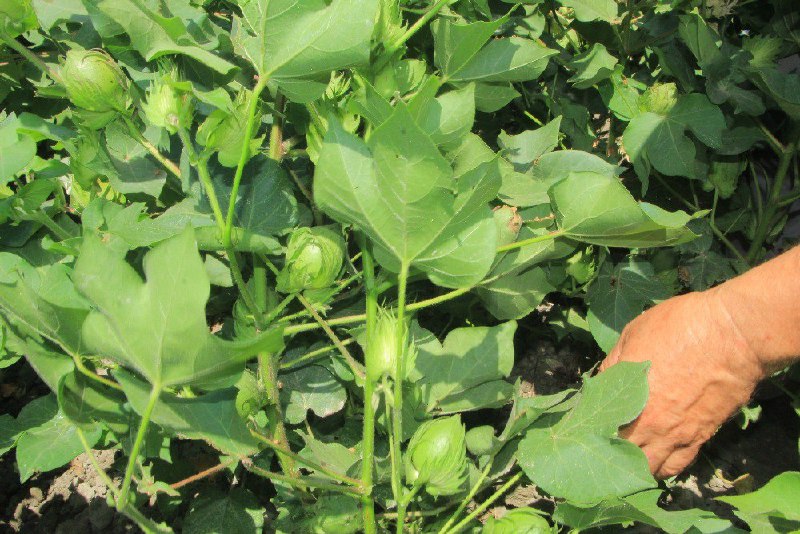
When ginning is carried out by hand, the top 1-2 cm part of the cotton head stem (it will be a little oozing color) is plucked (pinched). If three parts of the stem are pulled out 5-10 cm deep without doing so, it will have a negative effect on the cotton, and one or two pods and flowers will also be pulled out. This means 3-5 s/ha of fully ripened crops. For this reason, farmers and experts should conduct explanatory work among the workers before starting the harvesting process and seriously monitor the harvesting process.
In the mechanical method, chipping is carried out by placing the upper part of the cotton in front of the cultivator with a special device.
The chemical method of chilpish is effective and convenient in every way for the harvest and optimal growth of cotton. In this case, "Sojean", "Entojean", "Dalpiks" preparations are mixed with 250-300 l/ha of water in OVX and other spray devices 5-7 days before or 5-7 days after watering. Then the drugs are well absorbed through the leaves of cotton, spread evenly throughout the body and stop the division of plant cells, as a result, the cotton stops growing along and next to the cotton, the leaves turn dark green, the development and harvest of the plant accelerates, the bush becomes a compact juniper, the air exchange between the rows and the microclimate improve, in the upper part of the cotton 3-4 lumps appear. The main thing is that ripening is accelerated by 7-8 days, the weight of the first crop is 6-7 centners, the total yield is 3-8 s/ha and even more, and it is possible to harvest cotton in high grades in a short period of time.
In the case of chemical spraying, the water tank of the tractor is first filled to half with clean water, then the specified amount of the drug is put into both tanks in the same amount, and water is poured over it and filled to the end. It is thoroughly mixed with a special mixer of the tractor or by hand, after which it is allowed to spray on the field. In the regions of our republic, depending on the state of cotton development, it is recommended to use "Sojean" and "Entojean" drugs in the amount of 90-100 g per hectare, and Dalpix in the amount of 1.5-2.0 l.
If "Sojean" and "Entojean" drugs are sprayed at the beginning of the cotton growth period at the rate of 15 g/ha when the cotton is 20-25 cm tall, 45 g/ha at the beginning of flowering (cotton height 55-60 cm), then 90 g/ha is enough during the priming period. However, it is necessary to apply 100-105 g/ha to the cotton in the fields where these drugs were not used before.