
Agro_recommendation
LET'S GROW COTTON RESPONSIBLY IN CHILLA
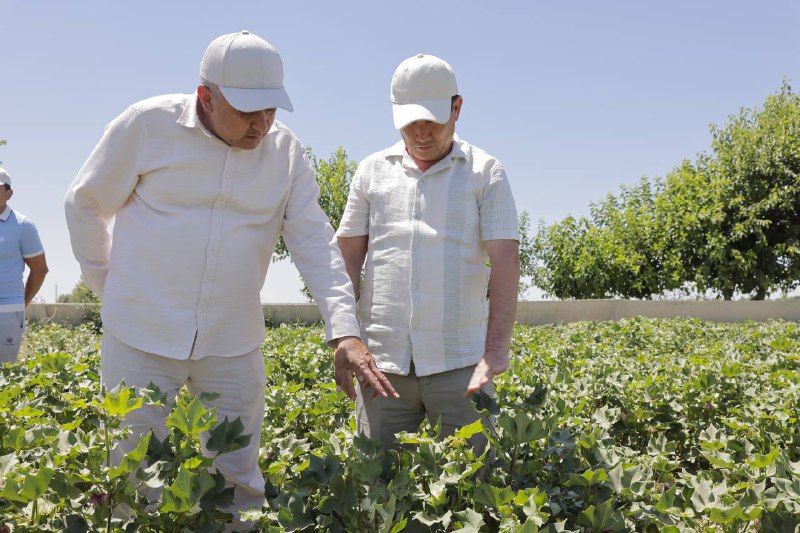
This year's timely implementation of the work performed during the summer chill in cotton care will ensure the quality and quality of the harvest. In this case, it is advisable to pay serious attention to cotton watering and weeding.
Irrigation is one of the main agro-measures in cotton care. The growth, development and harvest of the plant depends on the correct determination of the irrigation period and standards.
Taking into account the condition of the cotton, the mechanical composition of the soil and the hydromodule areas, the irrigation period, rate and number are determined as follows: in the lands where the water table is deeper than 3 meters, the rate of irrigation during the flowering and fruiting period of the cotton should be 800-900 m3 per hectare on light soils, and 900-1000 m3 on medium and heavy soils. It is necessary to make sure that the irrigation water is distributed in rows in the nearby lands, and that it is placed in a small measure and that the egates are replaced, i.e., the water is drawn from the egates that were not watered in the second irrigation.
⌛The duration of irrigation during the flowering period of cotton should not exceed 14-16 hours in light soils, 16-18 hours in medium and heavy soils, and 16-18 hours and 18-20 hours during full flowering and fruiting, respectively. Irrigation by the juice method has an important role in the efficient use of water and the complete absorption of mineral nutrients by cotton. In this case, the manure, along with being a nutrient, acts as a mulch, reduces excess evaporation of water, improves its absorption into the soil, and retains moisture well. Irrigation is stopped after the scheduled amount of water is given. Irrigation in fields with 60 cm between rows of cotton can save up to 15-20% of water.
After each watering, the cotton between the rows should be gently cultivated without creating lumps. In this case, the extensive use of the "boranka" method is effective.
‼From water to water, cotton is processed 2 times between the rows, in the second processing, a furrow is taken for irrigation. It is not necessary to deeply till the soil after watering. Mainly loosening the soil at a depth of 10-12 cm by installing a boranka or a large amount of KKO, prevents excess moisture evaporation, and keeps moisture in the soil well.
This makes it possible to extend the period between irrigations by 4-5 days and to save irrigation water once during the season without harming the growth, development and harvesting of the plant. Water use efficiency increases by 15-20% and cotton yield increases by 3-4 s/h.
Nitrogen and phosphorus fertilizers in the fields where cotton begins to flower make up 70-75 kg of pure nitrogen and 40-50 kg of pure phosphorus per hectare. Application of 500-700 kg of dry manure per hectare together with nitrogen fertilizers during cotton flowering periods increases cotton yield by 2.0 centners per hectare. The last period of feeding during the growing season should coincide with the beginning of flowering of cotton, that is, if it is delayed from July 5-10, it will delay the ripening of cotton.
Treatment with stimulants during cotton vegetation accelerates the growth and development of the plant, increases its resistance to diseases and pests, effectively uses mineral fertilizers, increases productivity by 10-15%, improves fiber and fiber quality. During the flowering period of cotton, Uzgumi is sprayed at the rates of 0.4 l/ha, Fitovak 400 ml/ha, Baikal EM1 3.5 l/ha, Mers 0.5 l/ha.
If our farmers follow the above recommendations, they will achieve a bountiful, high-quality cotton harvest, short-term harvesting, sales of cotton raw materials of high quality, and an increase in economic efficiency.
It was prepared by scientists of the Scientific-Research Institute of Cotton Selection, Seeding and Cultivation.